




If you’ve ever wondered how to find your watercolor style, I don’t think the answer is a new technique or the perfect tutorial. It’s noticing what you’re already drawn to, and then choosing it on purpose. This is what I’ve learned about it so far.
We are all creative beings.
We’ve all made something that didn’t exist before.
A smoothie. A birthday party. A garden. Every one of those things asks us to take stock of what we have (three sad bananas and a container of yogurt), make a series of choices (honey? ice? the last of the frozen mango?), and bring something into being that wasn’t there ten minutes ago.
That’s the whole thing. That’s the creative process.
What is an artist, again?
An artist, to me, is just someone who stays open to all the information they’re swimming in, and then becomes an active participant in the choices they make.
If you are looking to gain more confidence in your creative process check out this post “From Not Creative to Empowered Artist” and if you’re looking for a way (back) in to your practice, try “Overcoming Creative Blocks in Watercolor Painting“
Which brings me to the thing I’ve been circling for years now: I believe the most valuable thing a watercolor artist can do for herself is cultivate and protect her own voice.
This is as true for the hobbyist who just wants to make something that feels like hers…instead of a copy of a YouTube tutorial AND for anyone hoping to build a business around their practice. Invitation design, licensing, gallery work. It all starts here.

The questions I keep coming back to when I sit down to paint:
- What makes my perspective different?
- How do I translate a flower differently than the hundreds of other women on Instagram and TikTok painting watercolor florals?
- For licensing especially, I’m endlessly curious about the overlap between my point of view and what actually resonates with a wider audience.
None of this happens by accident, though. Here are three things I do to cultivate and protect my artistic perspective, plus one exercise to point you in (your unique) right direction.
1. Refine your palette
If painting is really just a string of choices, it helps to get conscious about what tugs at us to make certain aesthetic choices. Get curious about that moment of resonance.
There are soooo many of us moving through the day getting targeted by ads, influenced by actual influencers, or by our neighbors, or by that woman in the grocery store wearing an outfit so good you have to ask where her jeans are from.
What I’m getting at is: we all have taste.
Start noticing yours. Then start asking why.
What is it about that mug that you love? What makes that particular tree your favorite to look at?
You don’t have to do anything with the information. Just the noticing will start to trickle into your painting.
And if the answer is “I love it because someone whose style I love, loves it.” that’s still a valid answer. The answer almost doesn’t matter. What matters is waking up to the moment of resonance.
2. Study the inspiration. Then put it away.
I like to think of cultivating your voice as building a visual language. Over time you find the colors, the shapes, the subjects that can be repeated, adjusted, focused in on, expanded.
It’s the framework for a consistent body of work ~ something I struggled with for years, and because of that, it’s held my attention ever since.
Here’s the tension: scrolling Instagram or Pinterest floods your brain with everyone else’s visual language.
(A note on this: if you love someone’s work, it’s okay to copy it for practice. It’s not okay to practice it for commerce. And if you post it, tag them.)

~ The Through Line Exercise ~
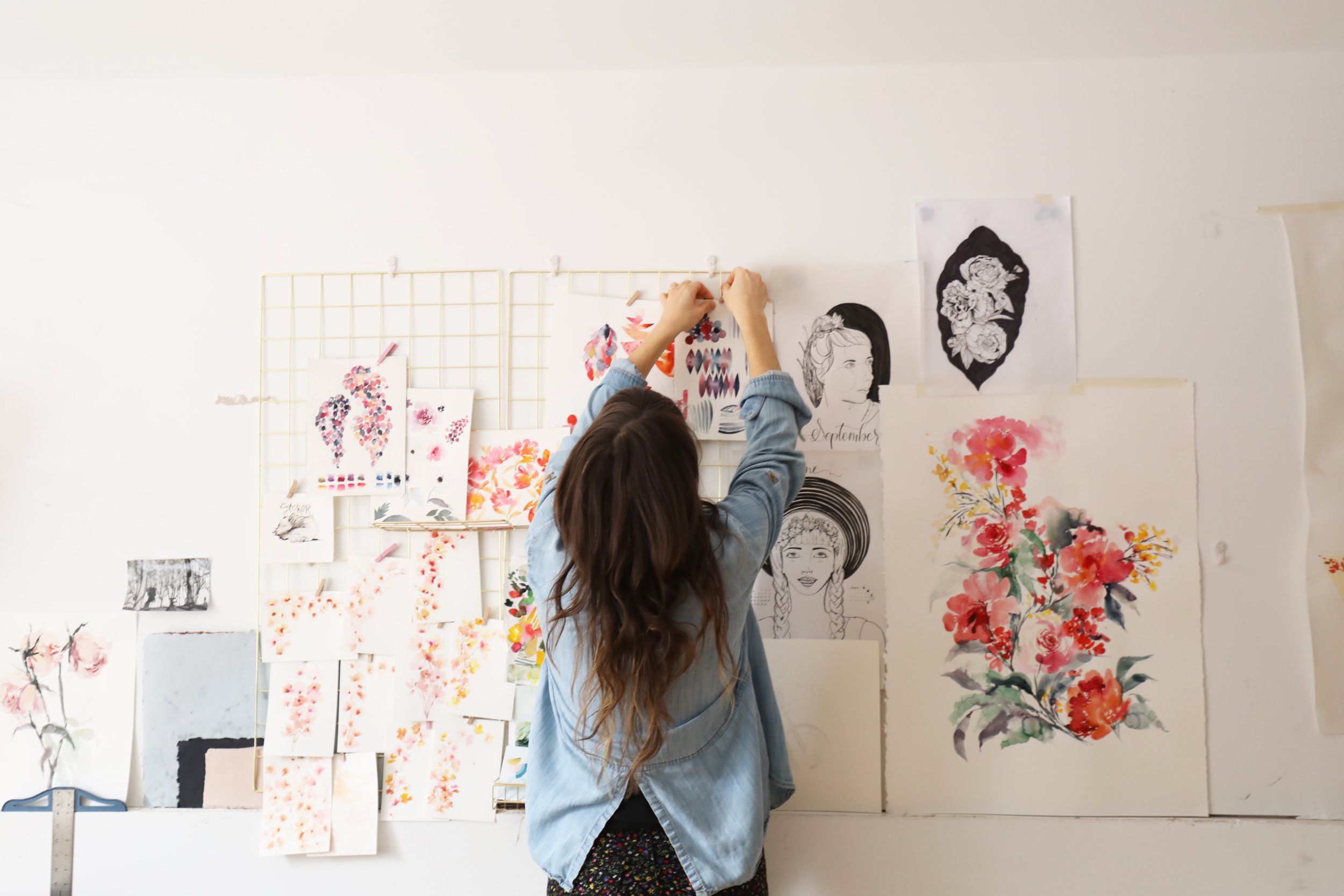
Here’s what I’d do instead. Save the pieces you love into a folder on your phone. Then drop them all onto a single page in Canva or PowerPoint and look for the through lines.
Is there a color that keeps showing up? Is everything tightly rendered, or is it all loose and whimsical? What’s the feeling that runs underneath?
Then, and this is the important part, put it away.
When you sit down to paint, their work goes out of view. That’s the moment to tap into you, and the wealth of lived experience you already have to pull from.
This lets you use references without borrowing someone else’s viewpoint wholesale. It becomes less about taking the thing they worked hard to clarify, and more about teasing out the direction you want to go.
3. Paint from observation
Painting from observation makes you pay attention.
You get to really look at your subject and make choices based on what you actually see, not what you assume it’s supposed to look like.
Sketch at the cafe. Buy a bunch of flowers and hold one in your hand while you paint it. Draw your kid’s face while they’re watching TV. Paint the shoes by the door, or something in your house you love. Or something you hate, like that pile of laundry you’re supposed to be folding.
Ten minutes a day will change your watercolors faster than you’d think.
I’m re-reading Rick Rubin’s The Creative Act right now, and I’ll leave you with this from his first chapter:
“Regardless of whether or not we’re formally making art, we are all living as artists. We perceive, filter, and collect data, then curate and experience for ourselves and others based on this information set. Whether we do this consciously or unconsciously, by the mere fact of being alive, we are active participants in the ongoing process of creation.”
This post is to remind us of that moment of choice, an opportunity to be conscious in the reality we create.
If you want more of this, I write about my studio practice, licensing and the creative life every week on my Substack. Come join me there 💜 And say hi on Instagram @jaimereynolds_, where I’m always sharing what’s on my painting table.